Equal Protection, Not Selective Protection: AAI Joins Muslim Organisations in Royal Commission Submission
-
by
AAI
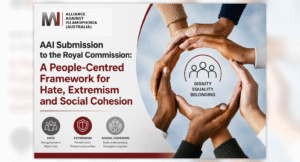
Alliance Against Islamophobia is proud to stand alongside Muslim community, legal, advocacy, anti-racism, monitoring, representative and victim support organisations in lodging a joint submission to the Royal Commission into Antisemitism and Social Cohesion.
This joint submission advances a clear and principled message: Australia must confront antisemitism seriously, while also ensuring that responses to racism do not silence Muslim Australians, Palestinians, Arabs, anti-genocide advocates, or people of conscience who speak for justice.
Social cohesion cannot be built through selective protection. It cannot be sustained when one community’s grief is treated with urgency while another community’s grief is treated as a risk. It cannot flourish when some communities are protected while others are securitised, mischaracterised, or made to feel that their lawful advocacy is inherently suspicious.
True social cohesion requires equal dignity, equal protection, institutional fairness and democratic space for all.
Social Cohesion Must Protect All Communities
The submission makes clear that social cohesion is not merely about communities physically coexisting. It is about whether people feel safe, protected, heard and able to participate in public life without fear.
Muslim Australians must be able to express religious and moral concerns, support humanitarian causes, participate in public debate, advocate for Palestinian rights, and raise issues of conscience without being collectively suspected or misrepresented.
When Muslim, Palestinian and Arab communities are treated as foreign, dangerous, politically illegitimate or less deserving of institutional protection, public trust is weakened. Communities become less likely to report harm, engage institutions, speak publicly, organise, protest or participate fully in civic life.
That is not social cohesion. That is exclusion.
Antisemitism Must Be Addressed Within a Broader Anti-Racism Framework
The joint submission affirms that antisemitism is real, harmful and must be addressed.
However, it must be addressed within a consistent national anti-racism framework, rather than through a separate or parallel architecture that risks treating some forms of racism as more urgent or more institutionally recognised than others.
Australia already has a national roadmap through the Australian Human Rights Commission’s National Anti-Racism Framework. This framework should be adopted, implemented and properly resourced as the core policy foundation for addressing antisemitism, Islamophobia, anti-Palestinian racism, anti-Arab racism and other forms of racism.
A serious response to antisemitism does not require the marginalisation of Muslim communities. A serious response to one form of racism must not create new forms of suspicion, silence or exclusion for others.
Islamophobia Is Directly Relevant to Social Cohesion
Islamophobia is not peripheral to the Royal Commission’s work. It is directly relevant to social cohesion in Australia.
Muslim Australians have faced growing levels of suspicion, dehumanisation, vilification and institutional exclusion. Palestinian and Arab communities have also experienced racism, censorship and the delegitimisation of their grief and advocacy.
If public institutions respond to antisemitism in ways that chill lawful Palestine advocacy, discourage Muslim civic participation, or treat anti-genocide speech as inherently suspect, social cohesion will be weakened rather than strengthened.
Communities are more likely to trust institutions when they see that protection is not selective, fairness is not conditional, and urgency is not reserved for one group while others are treated as problems to be managed.
Lawful Palestine Advocacy Must Be Protected
A central concern of the joint submission is the need to distinguish antisemitism from legitimate political expression.
Hatred directed at Jewish people because they are Jewish must be confronted. It has no place in Australia.
At the same time, advocacy for Palestinian rights, opposition to genocide, criticism of occupation and apartheid, support for boycott activity, and criticism of Israel or Zionism as political structures are not inherently antisemitic.
Political speech must be assessed by its target, content and context. Criticism of states, governments, militaries, political ideologies and public policy positions must remain protected in a democratic society.
This distinction is essential. Without it, Muslim Australians, Palestinians, Arabs, students, workers, mosques, imams, Islamic schools, community organisations and peaceful protesters may feel pressured to avoid speaking, praying, fundraising, organising, advocating or protesting in legitimate ways.
That would be a profound failure of democratic participation.
Why the IHRA Definition Is a Serious Concern
The joint submission opposes the use of the IHRA working definition of antisemitism as the basis for government, institutional or public policy responses.
The concern is not about whether antisemitism should be addressed. It must be.
The concern is that the IHRA examples relating to Israel and Zionism create a serious risk that legitimate political expression will be mischaracterised as antisemitic.
Where the IHRA definition is used, it must not be applied mechanically. It must be accompanied by strong safeguards, full contextual assessment, procedural fairness and meaningful consultation with affected communities.
No definition should be used in a way that suppresses lawful advocacy, humanitarian speech, religious and moral expression, or peaceful protest.
Institutions Need Clear Guidance
Schools, universities, workplaces, public bodies, complaints agencies and law enforcement agencies need clear guidance.
They must be able to distinguish antisemitism from legitimate political expression, religious and moral speech, humanitarian advocacy and peaceful protest.
Policies and training must not be developed in isolation from the communities most affected by their implementation. Muslim, Palestinian and Arab communities must be consulted before institutional policies are adopted that may affect their rights, safety, speech or participation.
The submission also supports the Australian Muslim Advocacy Network’s Dehumanisation Framework as a practical standard for identifying harmful racist speech and discourse. This framework focuses on whether people, identified by a protected attribute, are portrayed as less deserving of equal human treatment.
It provides a clearer and more consistent basis for addressing hate while protecting legitimate criticism of states, governments, militaries and political ideologies.
Extremism Must Not Be Explained Through Religion-First Narratives
The submission also raises serious concerns about the use of terms such as “religiously motivated terrorism,” “radical Islam” or “Islamist extremism” as explanatory categories.
Religious language, symbols, flags or asserted justifications may form part of how a perpetrator frames an act. But they do not, by themselves, establish the root causes that led an individual to violence.
Religion-first explanations risk reinforcing Islamophobic narratives and collective suspicion towards Muslim communities. They can obscure the broader social, political, psychological and ideological factors that contribute to violence.
Public institutions must avoid language that treats Islam or Muslim identity as an explanatory shortcut for extremism.
Community-Led Monitoring Must Be Supported
The submission calls for stronger support for community-led monitoring, reporting and response mechanisms.
Communities affected by racism are often best placed to identify emerging patterns of harm, barriers to reporting and the practical impacts of institutional responses.
Organisations such as the Islamophobia Register Australia play a vital role in documenting anti-Muslim harm and helping institutions understand patterns that might otherwise remain invisible. This work should be supported as part of a broader national approach to racism, alongside reporting and monitoring mechanisms for antisemitism and other forms of racism
A Careful and Consistent National Approach
At its core, the joint submission calls for a careful, consistent and principled national approach.
Australia must be able to confront antisemitism seriously while ensuring that responses to racism do not silence other communities, narrow legitimate public debate, or create new forms of suspicion and exclusion.
Social cohesion is strengthened when communities can speak, grieve, disagree, advocate and participate within a framework of equal dignity, equal protection and institutional fairness.
This is the Australia we must build: a country where all communities are protected, all grief is recognised, all racism is taken seriously, and democratic participation is not treated as a threat.
Alliance Against Islamophobia is honoured to be a signatory to this important joint submission and will continue to advocate for an Australia where Muslim communities can participate fully, safely and confidently in public life.
Read the Joint Statement
The full joint statement on the lodgement of the Joint Muslim Community Submission to the Royal Commission into Antisemitism and Social Cohesion is available here:
Download the Joint Muslim Community Statement
The statement outlines a principled community position that social cohesion must be built through equal protection, institutional fairness, democratic participation and the right of all communities to speak, grieve, organise and advocate without collective suspicion.
Signatory Organisations
The joint submission was lodged by:
1. Alliance Against Islamophobia
2. Australian Federation of Islamic Councils
3. Islamophobia Register Australia
4. Islamic Council of Queensland
5. Islamic Council of Victoria
6. Islamic Council of Western Australia
7. Muslim Legal Network NSW
8. Muslim Votes Matter
9. Queensland Muslims Inc
10. The Muslim Vote
Dated: 22 June 2026.