What We Don’t Measure, We Don’t See
 admin@aai.support
A simple step towards tackling Islamophobia and other forms of racism in healthcare
When most people enter a hospital, they are not thinking about standards, accreditation or governance.
They are thinking about something much more immediate.
Will I be listened to?
Will my pain be taken seriously?
Will my family be treated with respect?
And for many people from Muslim and other marginalised communities, there can be another unspoken question
Will I be seen as an individual — or through assumptions about my name, appearance, dress, religion, ethnicity, caste, language or background?
The Alliance Against Islamophobia’s submission, Seen as an Individual: Racism, Islamophobia and Patient Safety, argues that one practical reform could help answer that question.
Australia should develop a short supplementary module to the Australian Hospital Patient Experience Question Set — AHPEQS — asking patients directly about discrimination, stereotyping, dignity and cultural and religious safety.
It sounds like a small change.
It could have a significant impact.
Because if we do not ask patients what they experienced, we may never see the patterns.
We already ask patients about their care
AHPEQS already measures important aspects of the hospital experience, including whether patients were listened to, whether their individual needs were considered, whether they were involved in decisions, whether information was understandable, whether pain was relieved and whether they felt safe.
But the current core questions do not explicitly ask whether a patient experienced racism, Islamophobia, stereotyping or discriminatory treatment.
That leaves an important gap.
A patient may receive appropriate treatment on paper while still feeling that assumptions affected how they were regarded.
Their pain may not have been taken seriously.
Their symptoms may have been dismissed.
Their family’s advocacy may have been interpreted as difficult or threatening.
A woman wearing hijab may feel assumptions were made about her independence.
A caste-oppressed patient may encounter assumptions connected with ancestry, surname or social status.
A person from another racialised or marginalised community may feel that their credibility or needs were filtered through a stereotype rather than assessed on their individual circumstances.
If health services never ask about these experiences, they can remain largely invisible.
Five questions could tell us a great deal
AAI proposes that the Australian Commission on Safety and Quality in Health Care co-design and validate a short AHPEQS supplementary module.
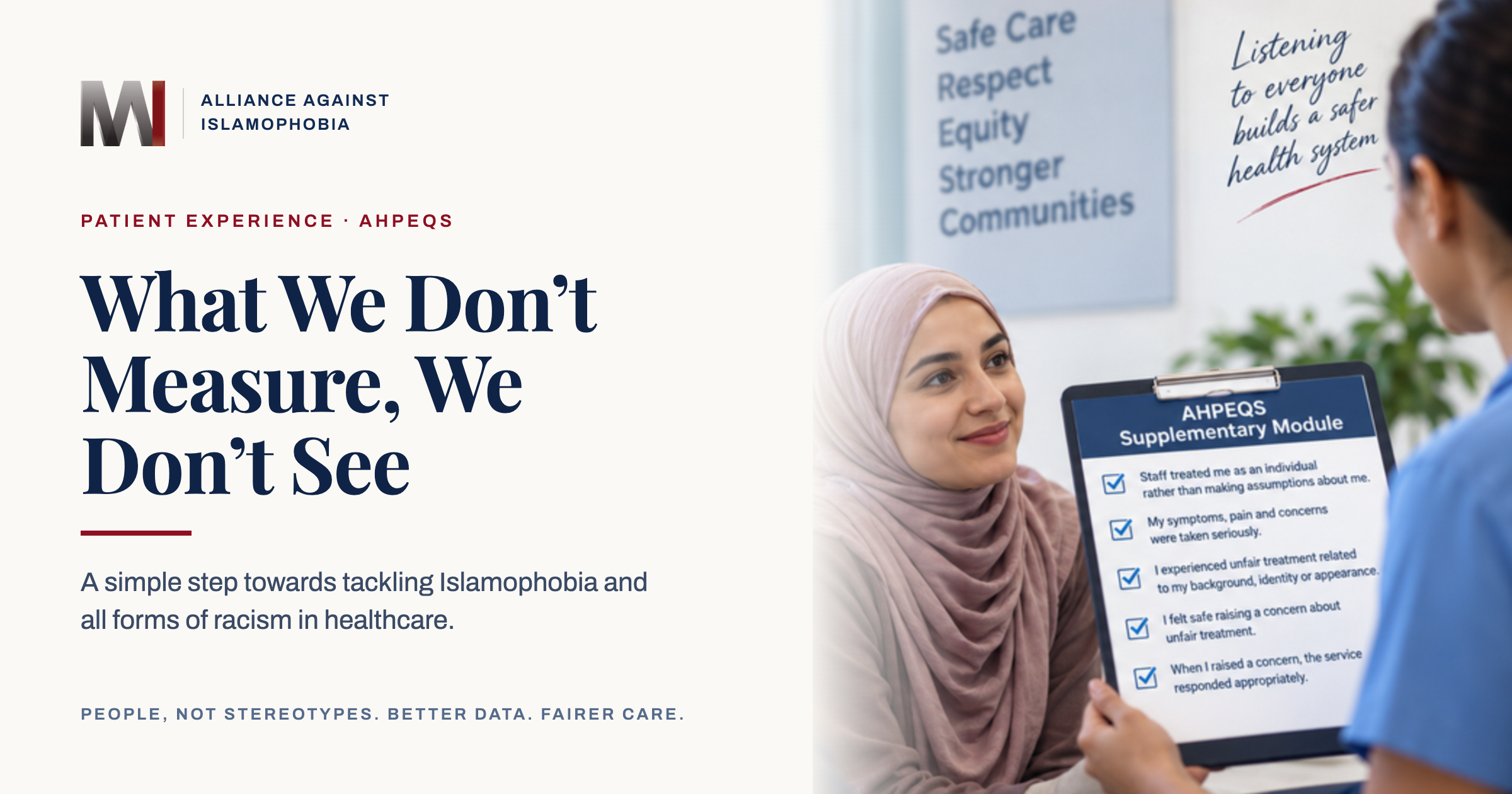
The submission offers five illustrative questions for testing:
Staff treated me as an individual rather than making assumptions about me.
My symptoms, pain and concerns were taken seriously.
During this care, I experienced unfair treatment that I believe was related to my background, identity or appearance.
I felt safe raising a concern about unfair treatment.
When I raised a concern about unfair treatment, the service responded appropriately
These are simple questions.
But they move the conversation from what hospitals say they do to what patients actually experience.
That is where transparency begins.
From policy to proof
There is a major difference between a hospital saying:
“We have a zero-tolerance policy on racism.”
and a hospital being able to say:
“We asked our patients whether they experienced unfair treatment. We identified a pattern. We investigated it. We changed our practices. We asked again. This is what improved — and this is what still needs work.”
That is accountability.
Policies, staff training and representative committees are important, but they cannot by themselves show whether patients experienced equitable care.
Why this matters for Muslim patients
Islamophobia in healthcare may not always appear as an openly hostile statement.
A supplementary AHPEQS module would not automatically prove that discrimination caused a particular clinical decision.
Its purpose is different.
It can help make patterns visible.
A framework that applies beyond one community
The submission also draws on the Dehumanisation Framework.
At its core, the framework helps identify what happens when people are reduced to assumptions about a group rather than treated as individuals.
That may include viewing a group as uniformly threatening, inherently dangerous, incapable of independent thought or collectively responsible
This has clear relevance to Islamophobia.
But its value is much broader.
A caste-oppressed person may encounter assumptions about status, worth, education, ancestry or background.
A refugee may be treated through stereotypes about credibility or behaviour.
A racialised or otherwise marginalised person may find that a category attached to them becomes more visible than the individual standing in front of the clinician.
The stereotype changes from community to community.
The underlying danger is similar:
the person disappears behind the assumption.
That is why the submission proposes using the Dehumanisation Framework in complaint assessment and training, helping clinicians, complaints staff and reviewers recognise patterns that can undermine dignity, individual agency and equitable care
Why complaints alone are not enough
Some may ask: if discrimination occurs, why not rely on formal complaints?
Because many patients never make one.
Some are too unwell.
Some do not know how.
Some believe nothing will change.
Some fear being labelled difficult.
And some worry that speaking up while they or their family still depend on the service could affect future care.
That is why low complaint numbers should not be treated as proof that discrimination is absent
A short patient-experience module could capture experiences from people who would never lodge a formal complaint.
It could become an additional early-warning system.
Importantly, an increase in reporting would not necessarily mean care had become worse.
It could mean patients finally feel safer speaking about what happened.
Better detection can look like more reports before it produces better outcomes.
Transparency must not come at the expense of privacy
Better measurement also raises legitimate questions.
That balance is essential.
The purpose is not to catalogue people.
It is to understand their experience of healthcare.
Asking is only the beginning
Measurement is useful only if it leads to action.
The submission proposes a straightforward improvement cycle:
Collect experience → identify patterns → set priorities with patients → co-design change → implement → evaluate → report back.
That final step matters enormously.
Report back.
If patients say they are being stereotyped, what changed?
If caste-oppressed communities identify a recurring concern, how was it examined?
If people say they do not feel safe raising discrimination, what was done to improve reporting?
And after action was taken:
Did the experience improve?
That is what turns consultation into accountability.
A simple question with enormous significance
Perhaps the most powerful proposed question is also the simplest:
“Staff treated me as an individual rather than making assumptions about me.”
Imagine every hospital routinely asking its patients that question.
Imagine boards seeing the answers.
Imagine patterns being investigated.
Imagine communities being told what changed.
The patient in front of a clinician is not a stereotype.
Not a religion.
Not a caste.
Not an ethnicity.
Not an accent.
Not a social category.
They are a person.
A short AHPEQS supplementary module could help turn equitable healthcare from an aspiration into something Australia can actually see, measure and improve.
Read the full AAI submission
For the full recommendations, proposed amendments to the National Safety and Quality Health Service Standards, evidence base and implementation safeguards, read AAI’s complete submission:
Seen as an Individual: Racism, Islamophobia and Patient Safety
Alliance Against Islamophobia, September 2026
The AAI submission is endorsed by the Australian Federation of Islamic Councils, Australian Muslim Advocacy Network, Islamic Council of Queensland, Islamic Council of Victoria, Islamic Society of South Australia, Muslim Votes Matter and Queensland Muslims Inc.
For Muslim Australians, caste-oppressed communities and others who experience marginalisation, greater transparency could help ensure that their experiences are recognised rather than overlooked.
Because the first step towards addressing discrimination is knowing that it is happening.
And sometimes one of the most powerful reforms begins with something very simple: